01
Place the moment
“On Sunday mornings…” or “When I moved into my first flat…” sets the scene. Use a date only if you know it.
How to write a memorial tribute
A memorial tribute is a personal way to remember someone. Describe one moment, include a detail that belonged to them, and say why it stays with you. You do not have to tell a whole life story.

A small, honest beginning
Instead of searching for the perfect description, remember something they actually did. An ordinary moment often gives you more to say than a list of qualities.
Follow a simple outline Read three complete examplesA simple memorial tribute outline
01
“On Sunday mornings…” or “When I moved into my first flat…” sets the scene. Use a date only if you know it.
02
Write what they did or said. If you are not sure of the exact words, describe the meaning without quotation marks.
03
A chipped cup, a tune, a folded note or the way they knocked can make the memory recognisable.
04
Explain why you remember it, or speak to them directly. A simple “I miss those afternoons” is enough.
From a description to a memory
“Dad was generous and helped everyone.”
“When Dad drove me to my first flat, he fixed the loose kitchen handle before bringing in his own bag. I still notice that handle every time I come home.”
This is an illustrative rewrite. You do not need a dramatic story; the detail should be something you actually remember.
A short message comforts or shares a memory. A tribute to read aloud needs a clear beginning, one story and room to pause. A story on a memorial can sit beside a photograph and be added to later. Choose the form that helps you say what you mean.
An example to learn from
I will remember Daniel making room for one more person at Sunday lunch. Even when I arrived late, he said I was just in time. I am thinking of you all.
Names a specific habit instead of only saying he was kind.
Keeps the focus on the person and their family.
An example to learn from
I am Elena, Daniel’s daughter. Dad had a habit of asking how many people were coming for lunch, then setting four extra places. I used to tell him that everybody was already there. He would say, “Well, someone might come by.” A friend of mine once turned up after a difficult morning. Dad did not ask for an explanation. He found another chair and asked her to pass the bread. That was how he made people feel welcome: by making room, without making a fuss. When we sit down together today, I hope we can make that same room for one another. Thank you, Dad, for showing us how.
Introduces the speaker and gives one story a beginning and an ending.
Uses short sentences that can be spoken, with room to pause.
An example to learn from
The table was already full when Dad brought out another chair. He had heard that our neighbour was eating on her own. He did not announce anything; he just put a plate beside mine. I remember the scrape of the chair on the kitchen floor and the way he moved the bread basket so she could reach it. This photograph was taken after lunch, when nobody wanted to be the first to leave.
Adds details that make sense beside a photograph.
Leaves space for another person to remember the same afternoon differently.
Memorial tribute examples
Original writing examples for reference. Keep the structure; use your own memories.
For a guestbook or a note to the family
You always saved the seat by the window because you knew I liked to watch the street. I still choose that seat. It reminds me how often you noticed the small things without being asked.
For a funeral or memorial gathering
I knew my uncle through Saturday mornings. He would arrive with a newspaper under his arm and ask what needed doing, though he usually stayed for tea instead.
When I moved into my first flat, he brought two mismatched mugs. “You need one for a visitor,” he said. That was how he made a place feel less lonely: not with a speech, but with another cup on the table.
I know many of you have your own version of that story. Mine is small, but it is the one I wanted to share today. I will miss those Saturdays, and I will keep a second mug ready.
For a page people can return to
This photograph was taken just after lunch. You cannot see the extra chairs we had borrowed, or the plate Dad kept warm for someone who was running late.
He would ask how many people were coming, then add four. We used to tease him about it. Looking at the table now, I think he simply liked the possibility that someone else might arrive.
There are things I cannot remember about that afternoon: the date, what we ate first, who took the photograph. But I remember that nobody had to ask whether there was room.
Before you share
You can leave parts of a relationship unspoken. Write from your own experience, keep the words private, or come back another day. A short message can be a complete tribute.
Bring your words into a memorial. Add their name and a photograph, then see how it feels.
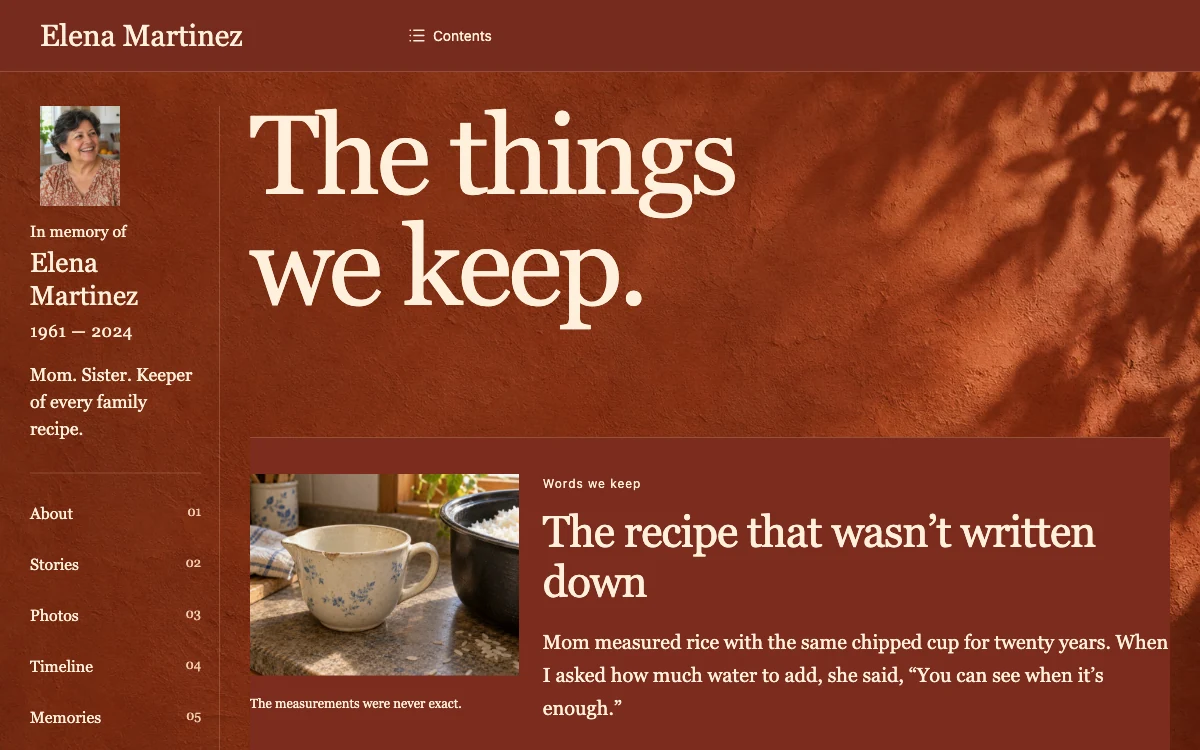 Your starting designWords We KeepView design
Continue to keep these words in this tab while you sign in. Save them to your account when you choose “Save draft”.
Free to prepare and preview. US$59.90 / year or US$119.90 once for one memorial.
Start with a blank memorial insteadWhen you are ready
The tribute you have just shaped can become the first entry in a private memorial that keeps the words beside the photographs, the voice and the people who remember them.
Continue in your own way